
One year of small notes: what a journal actually looks like after 12 months
Not a scrapbook. About sixty fragments, most of them under a line, and a picture of a year that no photo album can produce.
By Baby Kangoo Team
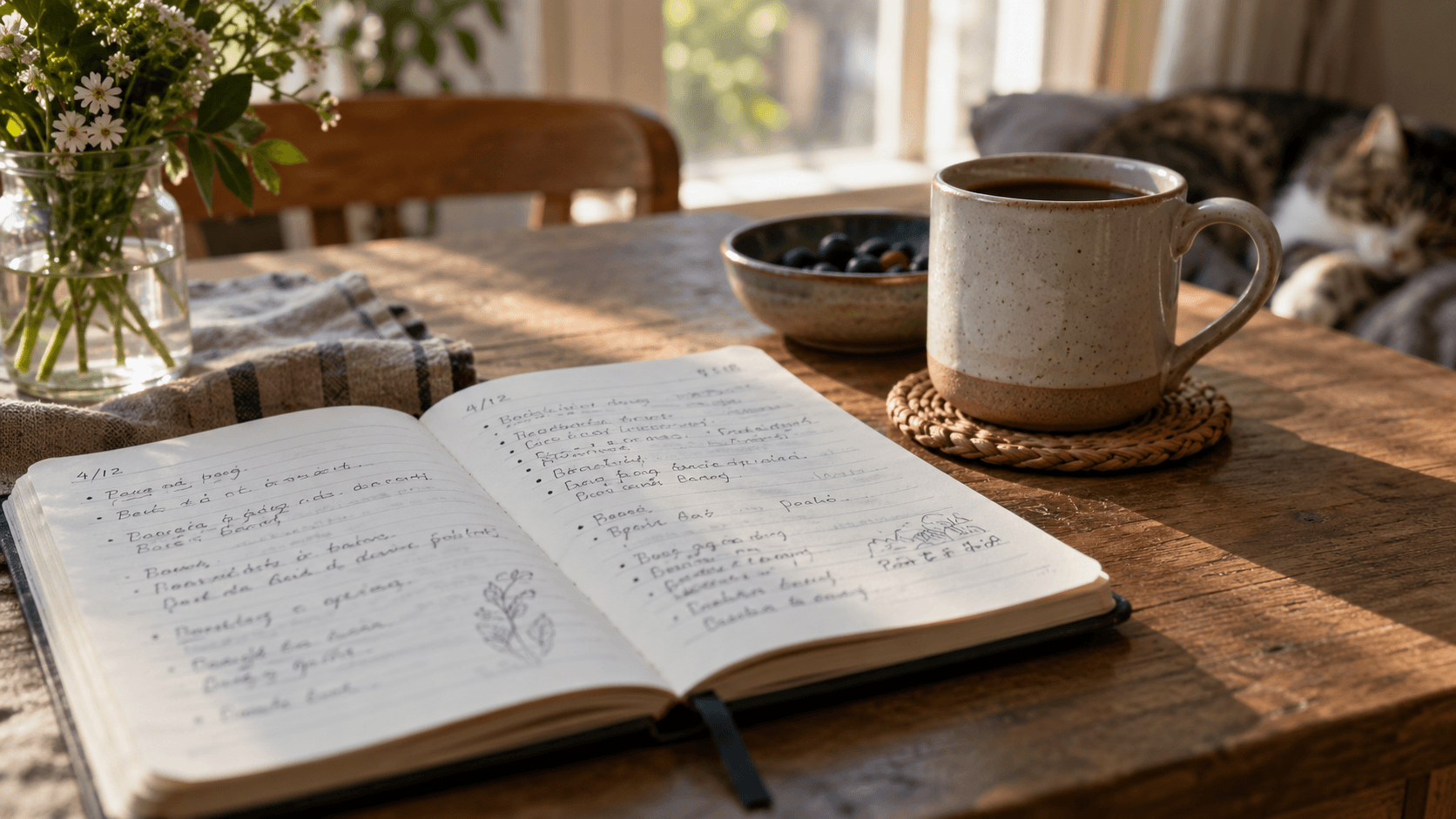
It's worth being honest about what a year of this actually amounts to, because the word "journal" suggests something it isn't.
It isn't daily. Almost nobody manages daily, and the people who try mostly stop in March. It isn't beautiful, it isn't complete, and large parts of the year are simply missing — usually the parts where everyone was ill or moving house.
What it is, after twelve months, is roughly sixty fragments. Most of them under a line.
What's actually in there
Read one back and the striking thing is how unimpressive each entry is on its own.
Says "og" for dog. Third night in a row. Refused the blue cup, specifically. Slept on me the whole film. Hates the hand dryer. Walked to the end of the hallway and looked around to check we'd seen.
Nothing there would survive on its own. Nobody would print any of it.
What happens when you read them together
They stop being notes and start being a shape.
You see the two months where sleep was the only thing anyone wrote about. You see a word appear, get used constantly for five weeks, and vanish without comment. You see the exact stretch where the entries get shorter and further apart, and remember, with a jolt, what was going on that autumn.
"I could see the week he changed. It's just three lines, but you can see it."
That's the part photographs can't do. A photo says what someone looked like on one afternoon. Sixty fragments say what a year was like — its rhythm, its preoccupations, the things that mattered enough to be written down twice.
What it's worth to the person it's about
Eventually your child asks what they were like. Everyone does.
And the usual honest answer is a small number of anecdotes, polished by retelling, plus a large number of photographs of a person they can't remember being.
The alternative is being able to say: for about a month, when you were eleven months old, you called the dog "og", and you said it at the window every morning, and we all started saying it too.
Which isn't a better story than the anecdotes. It's a different kind of thing entirely — evidence that somebody was paying attention to the parts that didn't matter.
If you're starting now
The trap is deciding to do it properly. Properly means a system, and a system means a thing to fall behind on.
What works is much less:
- One line, when something strikes you. Not on a schedule
- Firsts, endings and changes, with the date — those are the ones that pay off later
- Their exact words, spelled how they say them
- Gaps left as gaps. No catching up, ever
Sixty lines a year is one every six days. That's the whole commitment, and it's enough.
The last thing
Everything in this Journal for the past month has come back to the same observation, from different directions: the things that feel too ordinary to record are exactly the ones that disappear, because being ordinary is what makes them invisible.
The milestones will look after themselves. Somebody will photograph the birthday.
It's the Tuesday that needs you.